November 21, 2007
waterboarding. really? really?!
I know I'm a little late on this. But honestly, who cares? This is important. Let's follow the link trail. Even if you followed the issue but haven't seen these particular things, take a second.
 It started with Mark Morford's column titled "Outrage Fatigue?". From there, we find ourselves watching Keith Olbermann talk about waterboarding in general, as well as its wider implications (transcript). This was the "holy shit" moment for me. I've heard the word waterboarding tossed around, and I kinda assumed it was a synonym for Chinese Water Torture, but when you watch the video and see the demonstration and listen to the description of it by someone who underwent it... that fired me up in a way I don't often get.
Olbermann reads Daniel Levin's quote:
And he wrote that even though he knew those doing it meant him no harm, and he knew they would rescue him at the instant of the slightest distress, and he knew he would not die — still, with all that reassurance, he could not stop the terror screaming from inside of him, could not quell the horror, could not convince that which is at the core of each of us, the entity who exists behind all the embellishments we strap to ourselves, like purpose and name and family and love, he could not convince his being that he wasn't drowning.
If you read that and you can condone the United States of America, the country "of the people, by the people, for the people" doing that in your name, then, seriously, fuck you.
November 02, 2007
amateur security just makes it worse
Bruce Schneier just posted an article on his site which calls out many current counter-terrorist "strategies" as useless or downright harmful. It's worth a read, but it will make you angry at incompetence.
Even worse: after someone reports a "terrorist threat," the whole system is biased towards escalation and CYA instead of a more realistic threat assessment.
...
If you ask amateurs to act as front-line security personnel, you shouldn't be surprised when you get amateur security.
February 06, 2007
neutrality or bust
There is a lot of confusion about what people are calling the "Net Neutrality" issue. This article, the cover story in the Boulder Weekly last week, is a must read for anyone who is even a little confused about what's really going on. It's basically war (fuck you, pay me) on the broadband consumer. It's written for the layperson and does a great job of laying all the facts out there.
Any discussion of network neutrality inevitably resorts to metaphors. Fast lanes and slow lanes. Toll booths. Book stores and endcaps. KFC and Pepsi vs. McDonald's and Coke. The phone system vs. the postal system. Electrical outlets that accept toasters as readily as computers, and so on. Of course, these metaphors have their limitations because there's really nothing like the Internet. So, it helps to understand something about how the Internet functions.
February 01, 2007
Boston, you are retarded.
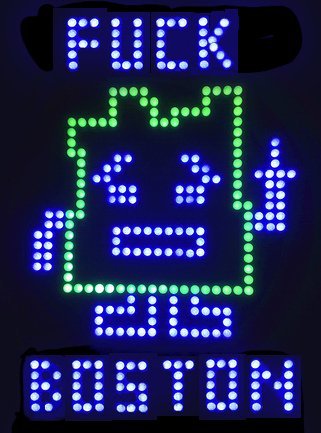
So if you haven't heard, Boston got its panties in a bunch over some LED signs that were part of a guerilla marketing campaign for Aqua Teen Hunger Force (ATHF), which is one of the most bizarre (and amusing) shows on [adult swim]. Then [adult swim] goes and puts this shit up on their website, completely validating Boston's reaction. Unbelievable. Boston can kiss my fucking ass. THEY'RE LEDS. Good lord.
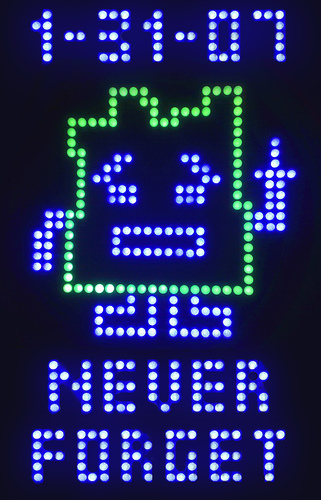
Tell them they suck for apologizing. I did:
I don't appreciate you validating the city of Boston's knee jerk retarded reaction to a harmless advertising campaign. I also don't appreciate you selling the advertising firm down the river so quickly. I realize you have a bunch of pussies in suits upstairs telling you what to do, but for $deity's sake, a disproportionate response to a bunch of LEDs doesn't require you to put on the kneepads and apologize profusely to a bunch of morans.
November 27, 2006
I don't trust you.
I recently got an email from MoveOn asking me whether I think they should support Nancy Pelosi's "100 hour plan".
After reading the article, I'm still left with that nagging "I don't trust you" feeling that I get whenever politicians speak. Her anti-lobbying proposals sound like a step in the right direction, but what isn't she saying? What are the loopholes she's left for herself? How eager will she be to enforce these rules when they hurt a Democrat?
She says "Pay as you go (no increasing the deficit)", but to do that, we raise taxes only on people with big annual incomes? Why not a flat tax? Rich people have time to find ways around paying taxes. It all unbalances itself eventually. Not all rich people are like Lois's dad in Family Guy. They can do good things with their money too. Forced charity is no charity at all.
I don't like Democrats. I don't like Republicans either. The reasons differ quite a bit, though... An example: Democrats want to force me to pay for other people's health care, while Republicans want to force me to pay to enable the killing of more Iraqi people, innocent or not. Neither is something that I approve of being forced to do, but one is clearly more moral (as moral as forceful redistribution of wealth can be). Which party gets the evangelical vote again? Explain that to me...
September 11, 2006
Brandalism: PsyOps for Ad execs
People abuse you every day. They butt into your life, take a cheap shot at you and then disappear. They leer at you from tall buildings and make you feel small. They make flippant comments from buses that imply you're not sexy enough and that all the fun is happening somewhere else. They're on tv making your girlfriend feel inadequate. They have access to the most sophisticated technology the world has ever seen and they bully you with it. They are the advertisers and they are laughing at you. However, you are forbidden to touch them. Trademarks, intellectual property rights and copyright law mean advertisers can say what they like wherever they like with impunity. Any advert in public space that gives you no choice whether you see it or not is yours. It's yours to take, re-arrange and re-use. You can do whatever you like with it. Asking for permission is like asking to keep a rock someone just threw at your head. You owe the companies nothing. You especially don't we them any courtesy. They have re-arranged the world to put themselves in front of you. They never asked for your permission, don't even start asking for theirs.-Banksy
August 24, 2006
assuming a ladder
"We, as a country, are now in the grip of five kinds of politics that I want very briefly to discuss, if only to alarm you and depress you. I call them the politics of assuming a ladder; the politics of rent seeking, otherwise known as the war against Wal-Mart; the politics of learned dependency; the politics of speech rationing; and the politics of orchid building. Let me explain these in very short compass.First, the politics of assuming a ladder. An old economics joke tells of an economist and a friend who are walking down a road and fall into a pit. The regular guy says, “We can’t get out.” And the economist replies, “Not to worry, we’ll just assume a ladder.” We have just had the last presidential election before the first of 77 million baby boomers begin to retire. They will put strains on a welfare state that, as currently configured, cannot endure. And so the entitlement advocates are assuming a ladder, assuming that something will happen to fix the problem.
- George Will, Upholding the Idea of Liberty
May 15, 2006
yay mexico
from TFA: (more coverage)
Possessing marijuana, cocaine and even heroin will no longer be a crime in Mexico if they are in small amounts for personal use under new reforms passed by Congress that quickly drew U.S. criticism.The measure given final passage 53-26 by senators in a late night session on Thursday is aimed at letting police focus on their battle against major drug dealers, and President Vicente Fox is expected to sign it into law.
...
The legal changes will also decriminalize the possession of limited quantities of other drugs, including LSD, hallucinogenic mushrooms, amphetamines and peyote -- a psychotropic cactus found in Mexico's northern deserts.
September 27, 2005
verizon phone lockdown illegal?
IANAL, but I just got a new phone and rather than paying Verizon to pull my old phone numbers off my lame LG VX6000, I transferred them over manually, culling the lame ducks in the process. So if I tell you I don't have your phone number anymore, you should laugh nervously. And then I read this article and thought perhaps what they did was illegal...?
If I don't want to have my data trapped in a proprietary format, I will avoid those proprietary applications. What is the sense of using the proprietary application and then asking for an open source tool to access the data?You own your data, even when it's trapped in a proprietary application. There is a term in American law, conversion, for the act of refusing to give back property of others that has been entrusted to you for safekeeping. This is probably illegal wherever you live, too, and when proprietary vendors trap your data and refuse to let you get at it except through their application, they may be committing a crime.
July 07, 2005
You create nothing.
Dear Equifax, Experian, and TransUnion (EEaTU),
First of all, I would like to congratulate you on pulling off what Matthew Lesko (?DORK) couldn't—being taken seriously. There are several differences between EEaTU and ?DORK, though, and I think they are important differences.
Everyone who knows what ?DORK does is amused and probably slightly annoyed that it makes him any money. He takes information freely published by the government and copies it into a book, which he sells, direct to the consumer. He might even add an index or something.
While this is the same type of sleight of hand that EEaTU performs, the information you gather is different in a very important way. It is not freely published by the entity it is primarily associated with. What you do is sell information about me and my financial history. You create nothing. You are slightly more technologically sophisticated than a filing cabinet. That's all you are, a container, a middleman. You had the foresight to not prance around in a pastel suit with question marks taped all over you, but that just makes you less retarded, which is an "accolade" I try to avoid.
Having the audacity to call information stored in your computers (you have computers, right?) about me a "product" really is appalling, though. Learn how to verify and secure "your" data and go look up "gross negligence" before you cry about the court-mandated bandaid for the hemorrhage of information about me out into the wild that you were essentially an accessory to.
hyperlinks subvert hierarchy yet again
For nearly four years - steadily, seriously, and with the unsentimental rigor for which we love them - civil engineers have been studying the destruction of the World Trade Center towers, sifting the tragedy for its lessons. And it turns out that one of the lessons is: Disobey authority. In a connected world, ordinary people often have access to better information than officials do.
...
We know that US borders are porous, that major targets are largely undefended, and that the multicolor threat alert scheme known affectionately as "the rainbow of doom" is a national joke. Anybody who has been paying attention probably suspects that if we rely on orders from above to protect us, we'll be in terrible shape. But in a networked era, we have increasing opportunities to help ourselves. This is the real source of homeland security: not authoritarian schemes of surveillance and punishment, but multichannel networks of advice, information, and mutual aid.
Question Authorities: Why it's smart to disobey officials in emergencies
the report these conclusions were drawn from (Occupant Behavior, Egress, and Emergency Communication)
where I got the phrase "hyperlinks subvert hierarchy"
June 24, 2005
rock the what?
What I got from Rock the Vote this week:
Wednesday morning, President Bush will speak at Montgomery Blair High
School in Silver Spring! He's going to promote his agenda for privatizing
Social Security.Join Rock the Vote as we make a showing for young people that we do not
want the debt, cuts and risk that come with privatization!
What I sent to Rock the Vote's intern listed in the Reply-To:
I appreciate what the organization you intern at is trying to do in getting young people more involved in politics, but I don't appreciate being pidgeonholed as not supporting Social Security privatization just because I happened to sign up for your mailing list. Rock the Vote is making the same mistake as AARP in the way they frame the discussion about changes to the current Social Security system, specifically:WSJ: AARP's False Campaign against Reform
and less specifically:cato.org: Problems and Criticisms
You should read those, if they're not blocked at your firewall because they disagree with you. It helps to read both sides of the argument.
June 02, 2005
feminony
That’s the lesson of the last week in sports: Feminism is phony. Sports are showbiz. Good-looking women get endorsements. Women who look and act like men don’t. Women who succeed against men on their own turf get respect. Women who constantly whine about equality—yet need their own, separate, unequal league to succeed—don’t get respect.
-Debbie Schlussel, Lesbian Basketball, Season 9 vs. the Indy Chick
May 27, 2005
guns and dope
A free people ought not only to be armed and disciplined,
but they should have sufficient arms and ammunition to maintain a
status of independence from any who might attempt to abuse them,
which would include their own government.
-George Washington
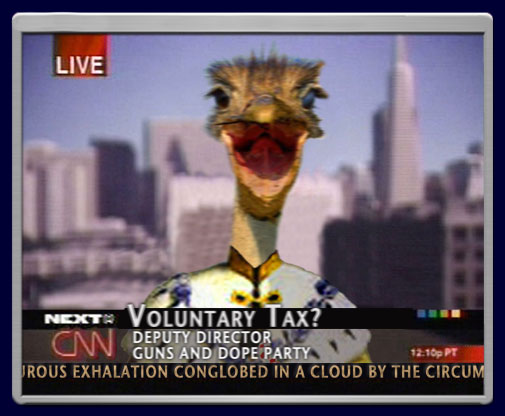
We advocate:
- guns for those who want them, no guns forced on those who don't want them (pacfists, Quakers etc.)
- drugs for those who want them, no drugs forced on those who don't want them (Christian Scientists etc.)
- an end to Tsarism and a return to constitutional democracy
- equal rights for ostriches.
May 10, 2005
two "clowns"
In this month's issue of Reason, there were two particular letters to the editor that caught my attention. One for its ability to get to the point, and the other for being ignorant. Both letters were in response to Ayn Rand at 100. Let's go in order, shall we?
The first gives a nice summary of some key Objectivist ideas that I happen to agree with:
"... that man must choose his values and actions by reason; that the individual has a right to exist for his own sake, neither sacrificing self to others nor others to self; and that no one has the right to seek values from others by physical force, or impose ideas on others by physical force."This letter is interesting to me because it is succinct, powerful, and to the point.
The author of the second letter, however, seems to be a bit underinformed:
We see a hint of what Objectivism has in store for the human race in the clown who, according to the Los Angeles Times, criticized the government for using tax-derived funds to provide relief for the victims of the tsunami that swept over South Asia last December. [can't find this... same idea]I wonder if Mr. Anthony rethought his condemnation of Objectivist principles when he read an article in the following month's Reason about how our protectionist government is already barring the countries affected by the Dec. '04 tsunami from helping themselves? (A clear violation of Objectivist philosophy.) To quote one of the articles from the search above, HOORAY FOR FORCED CHARITY!
That isn't even "Let them eat cake!" An Objectivist society would be a cold, vicious place, very much like our own during the age of the Robber Barons.
Dennis Anthony
Los Angeles, CA
My feeling on this is very well expressed in the responses to this Slashdot post. It goes like this:
I think *you* should learn about sharing. I do share. What I don't do is get mad at someone else who I don't think shares "enough" (whatever that means this week). Sharing is voluntary and people who think otherwise are usually only interested in sharing when they are on the receiving end of the share.
January 24, 2005
inferior usefulness through apathetic complicity
Governments, "as the true representatives of their country", should have an increased voice in the governance of the internet, Communications Minister Ivy Matsepe-Casaburri said on Thursday. Also, "It must be shared based on need. We must allow newcomers to enter in the same way as the more established users" (this is a red herring argument[1]).
Even if most government/bureaucratic structures weren't hopelessly corrupt (*cough*OilForFood), needlessly self-perpetuating, and overly complex (*cough*USTaxCode), hyperlinks subvert hierarchy. Command and control power structures are streamlined, if not obsoleted by the internet (i.e. empowering the individual), which is why China tries to block content it doesn't want its citizens to see. I wonder if Ivy thinks the Chinese government is a "true representative [of its citizens]"...
[1] I know what John Galt would say; "The only proper propose of a government is to protect man's rights..." The internet and the services it provides and enables is available with very limited restrictions. Letting governments get involved would only pollute that environment and add more barriers to entry.
January 20, 2005
social (homeland) security?
Whether you love or hate The Washington Post (I personally don't read it enough to have a valid opinion), you've got to respect them for presenting both sides of the current Social Security debate, For and Against.
You'll notice I didn't call the current Administration's plan by its scare-tactic label, "privatization" or what its proponents use, "individual accounts" or alternately (not directly) part of a paradigm shift towards an "ownership-oriented society". I don't like bs marketing words when easy explanations will work just as well. This is funny too. I prefer the explanations here, by the Cato Institute
September 16, 2004
Robert Jackson and Ayn Rand
One of the quotes that has stuck with me most since I read Atlas Shrugged [bn.com] is (somewhat paraphrased): "If we make everything illegal, then we can arrest whoever we want!" Atlas Shrugged came out in 1957, but before that, [cato.org]: in 1940, Attorney General Robert Jackson (later Justice Jackson) warned federal prosecutors: "With the law books filled with a great assortment of crimes, a prosecutor stands a fair chance of finding at least a technical violation of some act on the part of almost anyone." The great danger, said Jackson, is that "he will pick people that he thinks he should get, rather than pick cases that need to be prosecuted."
"Everything illegal?!", you exclaim in disbelief, "why, that's preposterous!" Read on, brave soul...
August 18, 2004
quiet discomfort
I went to Chipotle for lunch. But starting this post out that way, with that title won't (at least not yet) lead to the obvious conclusion. I subscribed to The Sun recently (no, not The Baltimore Sun) and, by the way, I've been pleased with the content so far. To paraphrase a self-described "fatcat Republican" in the letters to the editor this month, even if I don't completely agree with the opinions as such, it's always a pleasure to read a well-written and intelligently presented point. Ah yes, on to my point; there is an article about welfare "reform" (pdf) in this month's issue.
While I am generally against welfare (fosters entitlement, see Saudi Arabia), especially "health care as a right," this article raises several important independent points. The upshot is that a welfare system implemented by an inefficient bureaucracy and steered by politicians with their own agendas can barely accomplish its stated purpose, even assuming that the theoretical causes driving the need for welfare to begin with are being ameliorated, let alone in an economic and social environment that in many cases encourages a downward spiral.
So I think the strangest part about that whole experience was that I was reading this article in a Chipotle in the middle of suburban Columbia, surrounded by other middle-class white-collar workers. I can't imagine McDonald's pays Chipotle crewmembers (ingenius labelling, isn't it?) much more than regular McD's employees...
August 14, 2004
digital media competition, ass
from a /. thread:
[We should] treat the race to scramble and descramble content as a kind of market competition that should be unfettered by the DMCA--or new FTC rulesThis is the most intelligent thing I've heard anybody say about the copy protection controversy.
Back in the 70s and early 80s HBO was broadcast through the air like DirecTV. People used to build their own receivers using antennas made out of coffee cans (I know -- I had one). After HBO had harassed and threatened antenna owners for several years, the courts finally ruled that the company couldn't control what people did with the broadcast signal in their own homes. HBO's next move was to scramble the signal, which was easily defeated by those with access to spectrum analyzers but largely stymied the coffee-can community. The eventual solution was for HBO to join the cable world.
I always thought this was the sensible way to handle the controversy. Make companies do business in the real world, rather than letting them reshape [the world] to their needs [through legislation]. Lately our government has gone in the opposite direction, with legislators tailoring laws to suit the demands of their financial backers.
One thing that must be repeated over and over is that copyright infringement is not stealing, because copyright is not property. It's a temporary restriction imposed on everybody except the copyright holder. Copyright holders don't "own" anything, and copyright doesn't give them any extra rights, it takes rights away from everybody else for a limited time. Copyright infringement may cause financial losses, but so do lots of other things -- arson, vandalism, assault, murder, for example -- and we don't call those things theft.It's important to keep repeating this because the content industry has essentially hijacked the concepts of property ownership and theft. They play the part of the little old lady chasing a purse snatcher, and they label critics of current copyright laws as socialists threatening the whole concept of private property.
July 18, 2004
church + state = ethical economic system?
-Nicholas Klassen, Islamic Economics
While I wholeheartedly agree with the above quoted statement (poor economies would benefit enormously if their agricultural efforts weren't devalued and effectively ignored by US and EU subsidies), I regard the rest of the article as a philosophical step backward. While its main point that an Islamic economic system would be fundamentally more ethical than today's corrupt Western corporate system is certainly arguable, Bernard Lewis and I share the view that it is (at least, currently) unworkable and widely susceptible to backslides into thoroughly un-democratic situations.
As Mr. Lewis also mentions in the 1995 speech linked above, "Islam" can be creatively interpreted and requires a more specific definition. Islam when used in the context of an "Islamic institution" is not just that, it is also a political system that does not mesh well with change and democratic dissidence when the majority happens to go against divine decree.
May 18, 2004
an intriGAYing argument
"I believe that no religion should ever [expect] anyone [outside their religion] to believe anything. Therefore, if gay couples wish to join in a lifelong [legally recognized] union [with legal rights identical to heterosexual couples], that should be their right to do so. However, [labelling this union] "marriage" is not a defense of their inalienable rights [as a ctizen], but an attack on those people's beliefs that hold marriage to be a sacred God-given gift. To insist on the term "marriage" is to [provoke unnecessary conflict with] those who hold that homosexuality is immoral. We are supposed to be a tolerant society, so where is the tolerance to be found in those who wish to [impose] their will on Bible-believing Christians and Jews?"
-by J, taken out of context (additions mine, obviously, as they change or add to the original stated idea)
most of the stuff in that original post and the comments is garbage, but the above statement is an intriguing assertion, just as intriguing as the libertarian argument that marriage be privatized, or shifted from a legal status to that of a contractual agreement.
the best compromises leave both sides feeling as though they got taken. so from the religious POV, an immoral union would now be legal. and from the gay POV, they would have equal rights (which i realize requires legal changes, thanks cb) but wouldn't be labelled the same as hetero couples. who makes out like a bandit?
and, of course, then there's this:
There once was a guy named Dave,
Who kept a dead whore in his cave.
He said, "What the hell,
You get used to the smell,
And think of the money you save."
as well as Chris Rock's assertion that gay people should be allowed to be as miserable as the rest of the married public. <troll>i do see one problem, though: when you're a rich gay person, which gay person takes the role of the gold digger? i guess the one with the least money... so shouldn't rich gay people be against gay marriage, because it would allow a gay gold digger legal recourse after divorce once the marriage is legally recognized? </troll> (Eddie, I want half!)
if i could have it my way, gay couples could have a mutual contractual obligation (yes, i take the libertarian stance) with exactly the same rights a heterosexual married couple has. insisting on the term "marriage" is inflammatory and counter-productive because that's not really what this is about, it's about equal rights. so if you're not going to argue for sweeping changes to laws controlling the institution of marriage, at least attack the legal premise that civil unions aren't equal to "legally married" unions, don't attempt to provoke conflict over a word... that's not in anybody's best interest! (this is also an interesting read)
April 12, 2004
chasing kerry
http://www.rollingstone.com/features/nationalaffairs/featuregen.asp?pid=2895
"Why does the press do such a lousy job of covering the campaign?"
I love it when I get to read something as clearly and honestly written as this by someone who has the all-too-uncommon ability these days to recognize the absurd contrasts and inconsistencies between "official" and "accepted" speech and reality. While dressed up as a viking.
If you like this article, you'll get a kick out of The Cluetrain Manifesto
April 07, 2004
napster's historical precedent
The film industry of Hollywood was built by fleeing pirates. Creators and directors migrated from the East Coast to California in the early twentieth century in part to escape controls that patents granted the inventor of filmmaking, Thomas Edison. These controls were exercised through a monopoly "trust," the Motion Pictures Patents Company, and were based on Thomas Edison's creative property--patents. Edison formed the MPPC to exercise the rights this creative property gave him, and the MPPC was serious about the control it demanded.
(this is an excerpt from Lawrence Lessig's free book, Free Culture)
As one commentator tells one part of the story,
A January 1909 deadline was set for all companies to comply with the license. By February, unlicensed outlaws, who referred to themselves as independents protested the trust and carried on business without submitting to the Edison monopoly. In the summer of 1909 the independent movement was in full-swing, with producers and theater owners using illegal equipment and imported film stock to create their own underground market.With the country experiencing a tremendous expansion in the number of nickelodeons, the Patents Company reacted to the independent movement by forming a strong-arm subsidiary known as the General Film Company to block the entry of non-licensed independents. With coercive tactics that have become legendary, General Film confiscated unlicensed equipment, discontinued product supply to theaters which showed unlicensed films, and effectively monopolized distribution with the acquisition of all U.S. film exchanges, except for the one owned by the independent William Fox who defied the Trust even after his license was revoked.
The Napsters of those days, the "independents," were companies like Fox. And no less than today, these independents were vigorously resisted. "Shooting was disrupted by machinery stolen, and `accidents' resulting in loss of negatives, equipment, buildings and sometimes life and limb frequently occurred." That led the independents to flee the East Coast. California was remote enough from Edison's reach that filmmakers there could pirate his inventions without fear of the law. And the
leaders of Hollywood filmmaking, Fox most prominently, did just that.
Of course, California grew quickly, and the effective enforcement of federal law eventually spread west. But because patents grant the patent holder a truly "limited" monopoly (just seventeen years at that time), by the time enough federal marshals appeared, the patents had expired. A new industry had been born, in part from the piracy of Edison's creative property.
March 12, 2004
most?!
http://www.cnn.com/2004/TECH/ptech/03/11/resumes.fraud.reut/index.html
Breaking into a database is relatively easy because MOST DATABASE SERVERS ARE NOT PASSWORD PROTECTED, said Alfred Huger, director of engineering at anti-virus company Symantec.
Emphasis mine, obviously. That has got to be one of the stupidest things I've ever heard. EVERY database server I've ever used or even heard anything about has been pasword protected. I have an extremely hard time believing Mr. Alfred Huger's statement. The reporter should have at least asked him to provide a source to back up that statement. If I ever found out that a company that I bought a product or service from had a database (such as a database of attendees to, say, a university) that wasn't password protected, I would probably sue them. That's just gross negligence.
March 08, 2004
price disparity
I went to BJ's and Subway over my lunch break today. I bought soda at both places. At BJ's, I got 24 12oz cans of soda for $6.29 but at Subway I got a 12oz fountain soda for about a dollar IIRC. That's almost 400% more than BJ's charged me. BJ's smaller profit margins look a whole lot better when you multiply it by their volume, but you can't really beat the quick bang for the buck (read: i get screwed) at Subway.
I'm going to assume that they both make a profit off of selling soda, or put another way, that they sell it for more than they pay for it. Subway depends on its soda profit much more than BJ's, though, as evidenced by the fact that when you fill up a card with the free sub stamps, they require you to buy a soda in order to get your free 6-incher. I don't see anything wrong with that, as a matter of fact, it's quite clever of them to do that. It made me break out in a strangely mis-cheevy-us grin when I read the fine print. I guess I like figuring out why companies do seemingly strange things.
I don't really have a point, I just think it's funny that when you can buy regular retail products on eBay for half price that mainstream businesses can still get away with charging so much for sugar water even though other mainstream businesses charge a small fraction of the cost for the same product.
February 26, 2004
message of 'Passion'
http://www.heraldargus.com/content/story.php?storyid=4158
"A major message of this film is that power corrupts. The priests kept the people from reading Scripture and thus were able to control their interpretation of it. The Roman army held dictator power over the locals and treated the people like lowly animals — and criminals, even worse — and neither were at an advantage to stop the abuses."
February 18, 2004
rejection as a hobby
http://www.penny-arcade.com/news.php3?date=2004-02-19
I'm going to include a huge quote from today's PA news post because it is awesome. I'm also going to paraphrase it a little bit for my own purposes.
"You may be tempted to give ground to the notion that the "innovation" is gone from [stuff], like the part-time pop nihilists to whom all Internet argument is ceded. This is a hipster's gambit, and it's one you would do well to apply a belt sander to. What you are saying is that you are incapable of being pleased. Instead of turning up your nose at the rich feast placed before us, you might ask yourself if you want to be a person for whom nothing is satisfactory. That's the trick of that position - to become so enamored of your own refined palette that no morsel can surmount your culling mechanism. Understand that this isn't the same as liking everything. You can be a huge snob and still be semi-permeable to amusement. I certainly don't waste my attention on bad [stuff], and there's no need to invest your dwindling time and resources for [stuff] out of some twisted sense of equanimity. As far as the white stag "innovation" is concerned, if you're looking at the [mainstream] you may be hard-pressed to find it at times. ... My point is that if you focus entirely on [the mainstream], that's like opening your bedroom door a crack and referring to that visible sliver as "the universe." ... If ... you can't find some way to enjoy yourself, please send me your name and a picture so I can fucking avoid you. I don't want to catch whatever it is you have."
I cut out or translated the gaming-specific references to make the quote more general because this point is something that I also agree wholeheartedly with in the general case. I consider myself easy to amuse. What this means is that while other people are miserable for whatever reason, I'm usually finding a way to enjoy myself. The point that it's possible to be "a huge snob and still be semi-permeable to amusement" is great too. I'd like to add something to that, though. It's possible to be a huge snob and still be respectful of other people's amusement. It's basically the same concept as not being that vegan/vegetarian asshole who can't eat anywhere and makes everybody else's life more difficult. Just because you have special tastes that you don't compromise on doesn't make you special. It just makes you that much more of a dick. Kthx bye.
P.S. Not all veggies are assholes. But it bothers me that most people feel obligated to accomodate difficult people who project their aura of awkward compulsion without compunction.
February 13, 2004
the friday five (paranormal)
1. Are you superstitious?
I believe in karma to a certain extent, basically "what goes around comes around," but that's about it.
2. What extremes have you heard of someone going to in the name of superstition?
I've heard the obligatory stories about pro athletes not washing some article of clothing for a long time because they think it gives them good luck... I'm sure I could find some pretty crazy/stupid ones with google, too, but I don't actively try to perpetuate things that I don't see solid reasoning behind.
3. Believer or not, what's your favorite superstition?
(note: at this point i realized it's friday the 13th today...) I like the one about breaking a mirror giving you however many years of bad luck. So if you're really ugly, does that mean you'll have bad luck for your whole life? (cause you break mirrors when you look at them, haha) But what about that chick from The Shining? She still seems to be doing ok...
4. Do you believe in luck? If yes, do you have a lucky number/article of clothing/ritual?
Choices, chance, risk, they all play a big part in everything. My favorite (paraphrased) quote about luck is "Luck favors the prepared mind." I'm not going to post my lucky number because it's a secret and if everyone knew what it was, my advantage would go right out the window...
5. Do you believe in astrology? Why or why not?
astrology: the divination of the supposed influences of the stars and planets on human affairs and terrestrial events by their positions and aspects
No, I don't. Even the dictionary is skeptical. I don't believe in anything that doesn't allow me to have a choice about things I do. Anything that an astrologist is correct about is just chance, common sense, or intuition and has some other influence and explanation, other than perhaps gravity ("You will stay firmly planted on the earth, unless you jump, or get on an airplane, or walk up some stairs, or take an elevator...").
February 06, 2004
Pieism: The One True Religion
The Ten Pie Commandments:
1. You shall love Pie and all its fillings.
2. You shall not steal thy neighbors Pie.
3. You shall not worship any other gods other than the almighty Pie Gods.
4. You shall not mutilate any Pie.
5. You shall not disrespect Pie.
6. You shall set aside 3 days a week in devotion to Pie
7. You shall eat a Pie at least once a month.
8. You shall spread the holy name of Pie.
9. You shall not dishonor Pie in any way, shape, or form.
10. You shall not bear false witness against any person who follows Pieism.
January 02, 2004
ok ok
He's right about one thing, I did mis-state the the etymology of the N word. That's what I get for not looking up something that I seem to remember from somewhere.
As much as I could otherwise appreciate the Alanis reference, I'd like to explain to you the intended irony (indicated correctly, but I'll give you the benefit of the doubt for now that you just misunderstood me):
- White people oppress black people (aided and abetted by other black people, nothing is ever black and white, ha ha *groan*), make them slaves, and demean them by calling them the N word
- as an aside, I think the word has been stripped of any social value and should never be used by anyone, as this guy appears to argue at first glance
- time passes, slavery is abolished (by a white guy)
- the word is adopted by black culture in much the same way that the Yankee Doodle jingle and moniker was adopted by the American colonies, except when the N word is used by white people, they become racist somehow, instead of Americans not caring when Brits call them Yanks. (I agree it's not in good taste to use it, but it seems contradictory to say something and then berate someone else for doing as you do)
- the irony arises (although admittedly based on my incorrect assumption about the etymology of the word) when black people call white people ignorant racists, thus completing the cycle with "reverse discrimination" (which makes me laugh just typing that term, because it's based on an incorrect assumption itself, that discrimination and racism is a one-way street).
I'll continue the debate later, but I've got work to do.
January 01, 2004
get over yourself
Let me set the stage for you. A white humor columnist named Brent Batten in  decides to do a piece on a local rap concert that didn't happen because there was too much security. He decides further that he will tell this story using a style of writing directly derived from hip hop artists and culture. It is decidedly hilarious (you can read it here).
Of course, the anti-defamation crowd, and other easily offended people with no sense of humor got wind of this (ooh, scary hand gestures implying mock seriousness) grave injustice and decided to up the ante a bit and call Batten a racist.
Normally, this is where I would inject my hot beef opinion. But I'll finish telling the story first. Stop me if you've heard this one.
The editor of Naples News then offered his apology, in which he details his thought process while considering whether the article was appropriate for print. Batten soon followed suit, but what struck me about the apologies was that they were weasel apologies (tip hat to Scott Adams), like "I'm sorry you were offended by what I said" as opposed to "I'm sorry for what I said". Or at least that's how they appeared to me. And that's what I would have said: "I'm sorry you decided to be offended by something funny I wrote".
Sweet merciful crap, people, give me a break! Everything Batten wrote has shown up in a rap song at some point. And comedy bits like that are actually fairly common, where some sort of jive or ebonics or whatever is translated into more official-sounding language. And nobody cares except people who either enjoy or make a living by getting offended. Go bother SNL and its ilk, you hypocrites. At least be consistent.
To make a comparison, my friends love it when people make fun of them with a racial slant (my asian friends would love that pun). We even do it ourselves all the time (think the Beastie Boys in Professor Booty... "Well, I think it's booty!", or Tai Mai Shu - Chinese Rapper's Delight or Welcome to India - all people making fun of their own ethnic stereotypes). Black rappers make fun of geeky white people all the time and we eat it up. That's because we (again, I'm generalizing to create an unprovable point in the general case, although this point is true based on my limited sphere of acquaintances) have a sense of humor about racial issues and understand when a stereotype is being ridiculed to underscore how ridiculous it is that one blanket statement could be correctly applied to such a large group of people.
To call a white person a racist is an interesting accusation. Depending on the area of the country you live in, you have a statistically variable chance of being right. Yes, I'm saying a higher percentage of rednecks are racists than city dwellers. And I'm probably right, too. Does that make me a racist? I'm applying stereotypical generalizations to white people, which would get me labelled a huge flaming racist if I said something like that about black people. To say that Batten is a racist based on a conceptually unoriginal comedy piece he wrote which is basically plagiaraized directly from the group he's satirizing is based on some fundamentally flawed logic.
When a black person calls a white person a racist, many times there is a certain ironic insinuation by the accuser. The etymology of the N-bomb has it descending directly from the english word "ignorant". And the assumption many accusers make about white people who happen to offend racial sensibilities is that these white people are ignorant of issues and topics that are racially charged. There is a parallel here with the example of racial interaction between me and my friends. Instead of teasing and making fun with some sort of malicious intent, we're playfully hazing you. Welcome to the club. You are officially accepted into our culture. I think you'll like it better than the slave labor imposed by my jackass ancestors, just don't try to swipe the entitlement credit card. You will get made fun of occasionally, and that's ok. If you can't laugh at yourself (and the ridiculous stereotypes that are associated with you), I feel sorry for you and your humorless existence. Once we can learn to accept and embrace our differences, this country will be a much better place, but the anti-defamation industry will fight tooth and nail to keep us at each other's throats because that's what keeps their coffers overflowing.
December 31, 2003
deconstructing vacuous rap
http://www.feisar.de/content/gfx_en_gangstarapper.html
Fitty is a bit of a special case. He can only threaten to shoot someone so many times until it loses its edge. So he has to say things other than "I'm gonna f*#*$@ shoot you" to break up the threats. I can also partially forgive him for saying nothing and talking like an idiot because I'm not wearing a bulletproof vest at the moment, and he probably has some sort of firearm within reach.
This (see link) reminds me of a scene in Asimov's Foundation where logical analysis is applied to a transcript of an Imperial ambassador's visit. The result is that the ambassador said exactly nothing during his entire visit, even though the Mayor of the Foundation came away with the distinct impression that his planet was under Imperial protection.
I'm a big fan of conciseness and clarity. When I read books or articles, I like to have my dictionary handy so I can look up any words I don't understand and make fun of the author for being needlessly sesquipedalian if that's the case. As many of my friends and acquaintances are well aware, conversation fillers try my patience...
As an example, I was watching Russell Crowe on Letterman (I think it was Letterman, but who really cares) last night and he would not stop saying "an-dumb" whenever his pickled brain couldn't keep up with what he was trying to say. I was probably the only one (of three people) in the room who noticed it enough for it to bother me, but it was really pissing me off.
People will argue that unless you use said fillers, people will interrupt you and overwhelm the "conversation." I agree that some people will do that. However, I do not enjoy having serious discussions with the sort of person who will interrupt me to gain an argumentative advantage, and I do my best to end that sort of interaction as quickly as possible by being either intentionally painfully boring or extremely obnoxious.
Unless I'm in the mood to be cruel and amuse myself. A fun game is to play devil's advocate to anything a person like that says until they get frustrated and try to physically assault you. Or to loudly emphasize edge cases that punch holes in that person's points. Or to introduce tangent arguments that have no relevance to the topic of discussion but can be loosely connected (possibly by edge cases) and vigorously defended. Tangent arguments are a great way to shut someone up because it's relatively easy to find a subject that somebody knows nothing about. Once you have one of those subjects on the table, they will either admit they know nothing about that (no fun) or try to bluff their way through an argument, at which point you can make them feel stupid and punish them for interrupting you.
Did I say that out loud? Anyway, It's hard to find good conversation these days. "Course I love ya. I love alla ya. Fuh-real."
December 30, 2003
private social security?
http://www.foxnews.com/story/0,2933,70981,00.html
Social Security (SS) reform is no longer a third rail or silver bullet that allows candidates running against those who support it to flip their opponent's platform and run as anti-reform. In fact, SS reform has become a viable platform, as evidenced by numerous House and Senate races in 2002 (see article). It's about time.
People are sick of paying so much tax seeing nothing but perpetual governmental growth. The "individual accounts" being proposed by many proponents of SS reform would pull people's retirement funds out of the government's grubby little hands and put them into something akin to a 401(k) plan or an IRA. That sounds like a great idea to me. Now to go after the rest of the self-perpetuating and entitlement-syndrome-fostering welfare programs that are stifling the dreams and ambitions of the potentially better off. Value for value is the only kind of rewarding, enriching and moral transaction. None of this "Give me stuff, just because" crap.
If you've ever played an MMORPG, it's in your face all the time once you have things to give away. No beggars get anything from me unless they earn it, or unless they don't ask me and I see them trying hard to learn or advance themselves. But once you accept the poison pill that you can get something for nothing, all of your motivation dissolves, and you don't even value or respect the things you're given.
December 02, 2003
oooh, controversy
i watched The Reagans on Showtime last night. i can see what all the fuss is about, because it's not a pleasant picture that gets painted. Ronald as a naive, well-meaning, easily manipulated actor, and Nancy as a pouty control freak who ironically cedes control to her "psychic friend."
the problem with the "Information Age" is that there's just so much gosh darn information, which makes it easy enough to say or write whatever you want to be true, with grains of truth, or even a whole lot of truth, while leaving out or fabricating that one key thing that would (or does) turn the whole story on its ear. someone might notice, or it might be accepted as gospel truth.
i understand that history has been and is written by the victors and all that, but the process has sped up so much that it has become possible to alter reality within one's lifetime, decidedly to one's advantage by altering the public's perceptions. i'm a big believer in responsibility and the honor in taking responsibility for something (like the media, along with so many other people with wide public influence doesn't). without that trait, people become like the shells of people in Atlas Shrugged whose mantra is "It couldn't be helped." they repeat that saying over and over until it is defeated by the people who aren't afraid to be seen for what they really are, whose strengths and shortcomings flap in the breeze like so many standards (pun intended) proudly carried, announcing the presence of a conquering force.
grandiose metaphors are awesome.
November 24, 2003
IP rights for me, but screw you
http://www.smh.com.au/articles/2003/11/24/1069522516621.html
disney doesn't play well with others, doesn't pay royalties to peter pan owners
This is not news. This is definitely newsworthy and should be reported everywhere, but this is obvious to anyone paying attention. Disney got the US government to change copyright laws so Mickey wouldn't pass into the public domain, why not pull the old corporate two-face and disrespect someone else's intellectual property rights? The hospital probably has legal recourse to collect back royalties, but they're a freakin' hospital, not a decrepit corporate structure with voracious lawyers keeping the ignorant blue blood flowing through its veins. And the hospital is definitely not about to grease the wheels to get a law in its favor passed. Advantage mouse, for being an unscrupulous dick.
November 11, 2003
Gore-y details
AP story @ Yahoo!
________________
As Prepared for Delivery
Remarks
By Al Gore
November 9, 2003
FREEDOM AND SECURITY
...
For my part, I'm just a "recovering politician" -- but I truly believe that some of the issues most important to America's future are ones that all of us should be dealing with.
And perhaps the most important of these issues is the one I want to talk about today: the true relationship between Freedom and Security.
So it seems to me that the logical place to start the discussion is with an accounting of exactly what has happened to civil liberties and security since the vicious attacks against America of September 11, 2001 -- and it's important to note at the outset that the Administration and the Congress have brought about many beneficial and needed improvements to make law enforcement and intelligence community efforts more effective against potential terrorists.
But a lot of other changes have taken place that a lot of people don't know about and that come as unwelcome surprises. For example, for the first time in our history, American citizens have been seized by the executive branch of government and put in prison without being charged with a crime, without having the right to a trial, without being able to see a lawyer, and without even being able to contact their families.
President Bush is claiming the unilateral right to do that to any American citizen he believes is an "enemy combatant." Those are the magic words. If the President alone decides that those two words accurately describe someone, then that person can be immediately locked up and held incommunicado for as long as the President wants, with no court having the right to determine whether the facts actually justify his imprisonment.
Now if the President makes a mistake, or is given faulty information by somebody working for him, and locks up the wrong person, then it's almost impossible for that person to prove his innocence -- because he can't talk to a lawyer or his family or anyone else and he doesn't even have the right to know what specific crime he is accused of committing. So a constitutional right to liberty and the pursuit of happiness that we used to think of in an old-fashioned way as "inalienable" can now be instantly stripped from any American by the President with no meaningful review by any other branch of government.
How do we feel about that? Is that OK?
Here's another recent change in our civil liberties: Now, if it wants to, the federal government has the right to monitor every website you go to on the internet, keep a list of everyone you send email to or receive email from and everyone who you call on the telephone or who calls you -- and they don't even have to show probable cause that you've done anything wrong. Nor do they ever have to report to any court on what they're doing with the information. Moreover, there are precious few safeguards to keep them from reading the content of all your email.
Everybody fine with that?
If so, what about this next change?
For America's first 212 years, it used to be that if the police wanted to search your house, they had to be able to convince an independent judge to give them a search warrant and then (with rare exceptions) they had to go bang on your door and yell, "Open up!" Then, if you didn't quickly open up, they could knock the door down. Also, if they seized anything, they had to leave a list explaining what they had taken. That way, if it was all a terrible mistake (as it sometimes is) you could go and get your stuff back.
But that's all changed now. Starting two years ago, federal agents were given broad new statutory authority by the Patriot Act to "sneak and peak" in non-terrorism cases. They can secretly enter your home with no warning -- whether you are there or not -- and they can wait for months before telling you they were there. And it doesn't have to have any relationship to terrorism whatsoever. It applies to any garden-variety crime. And the new law makes it very easy to get around the need for a traditional warrant - simply by saying that searching your house might have some connection (even a remote one) to the investigation of some agent of a foreign power. Then they can go to another court, a secret court, that more or less has to give them a warrant whenever they ask.
Three weeks ago, in a speech at FBI Headquarters, President Bush went even further and formally proposed that the Attorney General be allowed to authorize subpoenas by administrative order, without the need for a warrant from any court.
What about the right to consult a lawyer if you're arrested? Is that important?
Attorney General Ashcroft has issued regulations authorizing the secret monitoring of attorney-client conversations on his say-so alone; bypassing procedures for obtaining prior judicial review for such monitoring in the rare instances when it was permitted in the past. Now, whoever is in custody has to assume that the government is always listening to consultations between them and their lawyers.
Does it matter if the government listens in on everything you say to your lawyer? Is that Ok?
Or, to take another change - and thanks to the librarians, more people know about this one - the FBI now has the right to go into any library and ask for the records of everybody who has used the library and get a list of who is reading what. Similarly, the FBI can demand all the records of banks, colleges, hotels, hospitals, credit-card companies, and many more kinds of companies. And these changes are only the beginning. Just last week, Attorney General Ashcroft issued brand new guidelines permitting FBI agents to run credit checks and background checks and gather other information about anyone who is "of investigatory interest," - meaning anyone the agent thinks is suspicious - without any evidence of criminal behavior.
So, is that fine with everyone?
Listen to the way Israel's highest court dealt with a similar question when, in 1999, it was asked to balance due process rights against dire threats to the security of its people:
"This is the destiny of democracy, as not all means are acceptable to it, and not all practices employed by its enemies are open before it. Although a democracy must often fight with one hand tied behind its back, it nonetheless has the upper hand. Preserving the Rule of Law and recognition of an individual's liberty constitutes an important component in its understanding of security. At the end of the day they (add to) its strength."
I want to challenge the Bush Administration's implicit assumption that we have to give up many of our traditional freedoms in order to be safe from terrorists.
Because it is simply not true.
In fact, in my opinion, it makes no more sense to launch an assault on our civil liberties as the best way to get at terrorists than it did to launch an invasion of Iraq as the best way to get at Osama Bin Laden.
In both cases, the Administration has attacked the wrong target.
In both cases they have recklessly put our country in grave and unnecessary danger, while avoiding and neglecting obvious and much more important challenges that would actually help to protect the country.
In both cases, the administration has fostered false impressions and misled the nation with superficial, emotional and manipulative presentations that are not worthy of American Democracy.
In both cases they have exploited public fears for partisan political gain and postured themselves as bold defenders of our country while actually weakening not strengthening America.
In both cases, they have used unprecedented secrecy and deception in order to avoid accountability to the Congress, the Courts, the press and the people.
Indeed, this Administration has turned the fundamental presumption of our democracy on its head. A government of and for the people is supposed to be generally open to public scrutiny by the people - while the private information of the people themselves should be routinely protected from government intrusion.
But instead, this Administration is seeking to conduct its work in secret even as it demands broad unfettered access to personal information about American citizens. Under the rubric of protecting national security, they have obtained new powers to gather information from citizens and to keep it secret. Yet at the same time they themselves refuse to disclose information that is highly relevant to the war against terrorism.
They are even arrogantly refusing to provide information about 9/11 that is in their possession to the 9/11 Commission -- the lawful investigative body charged with examining not only the performance of the Bush Administration, but also the actions of the prior Administration in which I served. The whole point is to learn all we can about preventing future terrorist attacks,
Two days ago, the Commission was forced to issue a subpoena to the Pentagon, which has -- disgracefully -- put Secretary Rumsfeld's desire to avoid embarrassment ahead of the nation's need to learn how we can best avoid future terrorist attacks. The Commission also served notice that it will issue a subpoena to the White House if the President continues to withhold information essential to the investigation.
And the White House is also refusing to respond to repeated bipartisan Congressional requests for information about 9/11 -- even though the Congress is simply exercising its Constitutional oversight authority. In the words of Senator Main, "Excessive administration secrecy on issues related to the September 11 attacks feeds conspiracy theories and reduces the public's confidence in government."
In a revealing move, just three days ago, the White House asked the Republican leadership of the Senate to shut down the Intelligence Committee's investigation of 9/11 based on a trivial political dispute. Apparently the President is anxious to keep the Congress from seeing what are said to have been clear, strong and explicit warnings directly to him a few weeks before 9/11 that terrorists were planning to hijack commercial airliners and use them to attack us.
Astonishingly, the Republican Senate leadership quickly complied with the President's request. Such obedience and complicity in what looks like a cover-up from the majority party in a separate and supposedly co-equal branch of government makes it seem like a very long time ago when a Republican Attorney General and his deputy resigned rather than comply with an order to fire the special prosecutor investigating Richard Nixon.
In an even more brazen move, more than two years after they rounded up over 1,200 individuals of Arab descent, they still refuse to release the names of the individuals they detained, even though virtually every one of those arrested has been "cleared" by the FBI of any connection to terrorism and there is absolutely no national security justification for keeping the names secret. Yet at the same time, White House officials themselves leaked the name of a CIA operative serving the country, in clear violation of the law, in an effort to get at her husband, who had angered them by disclosing that the President had relied on forged evidence in his state of the union address as part of his effort to convince the country that Saddam Hussein was on the verge of building nuclear weapons.
And even as they claim the right to see the private bank records of every American, they are adopting a new policy on the Freedom of Information Act that actively encourages federal agencies to fully consider all potential reasons for non-disclosure regardless of whether the disclosure would be harmful. In other words, the federal government will now actively resist complying with ANY request for information.
Moreover, they have established a new exemption that enables them to refuse the release to the press and the public of important health, safety and environmental information submitted to the government by businesses -- merely by calling it "critical infrastructure."
By closely guarding information about their own behavior, they are dismantling a fundamental element of our system of checks and balances. Because so long as the government's actions are secret, they cannot be held accountable. A government for the people and by the people must be transparent to the people.
The administration is justifying the collection of all this information by saying in effect that it will make us safer to have it. But it is not the kind of information that would have been of much help in preventing 9/11. However, there was in fact a great deal of specific information that WAS available prior to 9/11 that probably could have been used to prevent the tragedy. A recent analysis by the Merkle foundation, (working with data from a software company that received venture capital from a CIA-sponsored firm) demonstrates this point in a startling way:
- In late August 2001, Nawaq Alhamzi and Khalid Al-Midhar bought tickets to fly on American Airlines Flight 77 (which was flown into the Pentagon). They bought the tickets using their real names. Both names were then on a State Department/INS watch list called TIPOFF. Both men were sought by the FBI and CIA as suspected terrorists, in part because they had been observed at a terrorist meeting in Malaysia.
- These two passenger names would have been exact matches when checked against the TIPOFF list. But that would only have been the first step. Further data checks could then have begun.
- Checking for common addresses (address information is widely available, including on the internet), analysts would have discovered that Salem Al-Hazmi (who also bought a seat on American 77) used the same address as Nawaq Alhazmi. More importantly, they could have discovered that Mohamed Atta (American 11, North Tower of the World Trade Center) and Marwan Al-Shehhi (United 175, South Tower of the World Trade Center) used the same address as Khalid Al-Midhar.
- Checking for identical frequent flier numbers, analysts would have discovered that Majed Moqed (American 77) used the same number as Al-Midhar.
- With Mohamed Atta now also identified as a possible associate of the wanted terrorist, Al-Midhar, analysts could have added Atta's phone numbers (also publicly available information) to their checklist. By doing so they would have identified five other hijackers (Fayez Ahmed, Mohand Alshehri, Wail Alsheri, and Abdulaziz Alomari).
- Closer to September 11, a further check of passenger lists against a more innocuous INS watch list (for expired visas) would have identified Ahmed Alghandi. Through him, the same sort of relatively simple correlations could have led to identifying the remaining hijackers, who boarded United 93 (which crashed in Pennsylvania)."
In addition, Al-Midhar and Nawaf Alhamzi, the two who were on the terrorist watch list, rented an apartment in San Diego under their own names and were listed, again under their own names, in the San Diego phone book while the FBI was searching for them.
Not to put too fine a point on it, but what is needed is better and more timely analysis. Simply piling up more raw data that is almost entirely irrelevant is not only not going to help. It may actually hurt the cause. As one FBI agent said privately of Ashcroft: "We're looking for a needle in a haystack here and he (Ashcroft) is just piling on more hay."
In other words, the mass collecting of personal data on hundreds of millions of people actually makes it more difficult to protect the nation against terrorists, so they ought to cut most of it out.
And meanwhile, the real story is that while the administration
manages to convey the impression that it is doing everything possible to protect America, in reality it has seriously neglected most of the measures that it could have taken to really make our country safer.
For example, there is still no serious strategy for domestic security that protects critical infrastructure such as electric power lines, gas pipelines, nuclear facilities, ports, chemical plants and the like.
They're still not checking incoming cargo carriers for radiation. They're still skimping on protection of certain nuclear weapons storage facilities. They're still not hardening critical facilities that must never be soft targets for terrorists. They're still not investing in the translators and analysts we need to counter the growing terror threat.
The administration is still not investing in local government training and infrastructures where they could make the biggest difference. The first responder community is still being shortchanged. In many cases, fire and police still don't have the communications equipment to talk to each other. The CDC and local hospitals are still nowhere close to being ready for a biological weapons attack.
The administration has still failed to address the fundamental disorganization and rivalries of our law enforcement, intelligence and investigative agencies. In particular, the critical FBI-CIA coordination, while finally improved at the top, still remains dysfunctional in the trenches.
The constant violations of civil liberties promote the false impression that these violations are necessary in order to take every precaution against another terrorist attack. But the simple truth is that the vast majority of the violations have not benefited our security at all; to the contrary, they hurt our security.
And the treatment of immigrants was probably the worst example. This mass mistreatment actually hurt our security in a number of important ways.
But first, let's be clear about what happened: this was little more than a cheap and cruel political stunt by John Ashcroft. More than 99% of the mostly Arab-background men who were rounded up had merely overstayed their visas or committed some other minor offense as they tried to pursue the American dream just like most immigrants. But they were used as extras in the Administration's effort to give the impression that they had caught a large number of bad guys. And many of them were treated horribly and abusively.
Consider this example reported in depth by Anthony Lewis:
"Anser Mehmood, a Pakistani who had overstayed his visa, was arrested in New York on October 3, 2001. The next day he was briefly questioned by FBI agents, who said they had no further interest in him. Then he was shackled in handcuffs, leg irons, and a belly chain and taken to the Metropolitan Detention Center in Brooklyn. Guards there put two more sets of handcuffs on him and another set of leg irons. One threw Mehmood against a wall. The guards forced him to run down a long ramp, the irons cutting into his wrists and ankles. The physical abuse was mixed with verbal taunts.
"After two weeks Mehmood was allowed to make a telephone call to his wife. She was not at home and Mehmood was told that he would have to wait six weeks to try again. He first saw her, on a visit, three months after his arrest. All that time he was kept in a windowless cell, in solitary confinement, with two overhead fluorescent lights on all the time. In the end he was charged with using an invalid Social Security card. He was deported in May 2002, nearly eight months after his arrest.
The faith tradition I share with Ashcroft includes this teaching from Jesus: "whatsoever you do unto the least of these, you do unto me."
And make no mistake: the disgraceful treatment suffered by many of these vulnerable immigrants at the hands of the administration has created deep resentments and hurt the cooperation desperately needed from immigrant communities in the U.S.and from the Security Services of other countries.
Second, these gross violations of their rights have seriously damaged U.S. moral authority and goodwill around the world, and delegitimized U.S.efforts to continue promoting Human Rights around the world. As one analyst put it, "We used to set the standard; now we have lowered the bar." And our moral authority is, after all, our greatest source of enduring strength in the world.
And the handling of prisoners at Guantanomo has been particularly harmful to America's image. Even England and Australia have criticized our departure from international law and the Geneva Convention. Sec. Rumsfeld's handling of the captives there has been about as thoughtful as his "postwar" plan for Iraq.
So the mass violations of civil liberties have hurt rather than helped. But there is yet another reason for urgency in stopping what this administration is doing. Where Civil Liberties are concerned, they have taken us much farther down the road toward an intrusive, "Big Brother"-style government - toward the dangers prophesized by George Orwell in his book "1984" - than anyone ever thought would be possible in the United States of America.
And they have done it primarily by heightening and exploiting public anxieties and apprehensions. Rather than leading with a call to courage, this Administration has chosen to lead us by inciting fear.
Almost eighty years ago, Justice Louis Brandeis wrote "Those who won our independence by revolution were not cowards. . . . They did not exalt order at the cost of liberty." Those who won our independence, Brandeis asserted, understood that "courage [is] the secret of liberty" and "fear [only] breeds repression."
Rather than defending our freedoms, this Administration has sought to abandon them. Rather than accepting our traditions of openness and accountability, this Administration has opted to rule by secrecy and unquestioned authority. Instead, its assaults on our core democratic principles have only left us less free and less secure.
Throughout American history, what we now call Civil Liberties have often been abused and limited during times of war and perceived threats to security. The best known instances include the Alien and Sedition Acts of 1798-1800, the brief suspension of habeas corpus during the Civil War, the extreme abuses during World War I and the notorious Red Scare and Palmer Raids immediately after the war, the shameful internment of Japanese-Americans during World War II, and the excesses of the FBI and CIA during the Vietnam War and social turmoil of the late 1960s and early 1970s.
But in each of these cases, the nation has recovered its equilibrium when the war ended and absorbed the lessons learned in a recurring cycle of excess and regret.
There are reasons for concern this time around that what we are experiencing may no longer be the first half of a recurring cycle but rather, the beginning of something new. For one thing, this war is predicted by the administration to "last for the rest of our lives." Others have expressed the view that over time it will begin to resemble the "war" against drugs -- that is, that it will become a more or less permanent struggle that occupies a significant part of our law enforcement and security agenda from now on. If that is the case, then when -- if ever - does this encroachment on our freedoms die a natural death?
It is important to remember that throughout history, the loss of civil liberties by individuals and the aggregation of too much unchecked power in the executive go hand in hand. They are two sides of the same coin.
A second reason to worry that what we are witnessing is a discontinuity and not another turn of the recurring cycle is that the new technologies of surveillance -- long anticipated by novelists like Orwell and other prophets of the "Police State" - are now more widespread than they have ever been.
And they do have the potential for shifting the balance of power between the apparatus of the state and the freedom of the individual in ways both subtle and profound.
Moreover, these technologies are being widely used not only by the government but also by corporations and other private entities. And that is relevant to an assessment of the new requirements in the Patriot Act for so many corporations -- especially in the finance industries -- to prepare millions of reports annually for the government on suspicious activities by their customers. It is also relevant to the new flexibility corporations have been given to share information with one another about their customers.
The third reason for concern is that the threat of more terror strikes is all too real. And the potential use of weapons of mass destruction by terrorist groups does create a new practical imperative for the speedy exercise of discretionary power by the executive branch -- just as the emergence of nuclear weapons and ICBMs created a new practical imperative in the Cold War that altered the balance of war-making responsibility between Congress and the President.
But President Bush has stretched this new practical imperative beyond what is healthy for our democracy. Indeed, one of the ways he has tried to maximize his power within the American system has been by constantly emphasizing his role as Commander-in-Chief, far more than any previous President - assuming it as often and as visibly as he can, and bringing it into the domestic arena and conflating it with his other roles: as head of government and head of state -- and especially with his political role as head of the Republican Party.
Indeed, the most worrisome new factor, in my view, is the aggressive ideological approach of the current administration, which seems determined to use fear as a political tool to consolidate its power and to escape any accountability for its use. Just as unilateralism and dominance are the guiding principles of their disastrous approach to international relations, they are also the guiding impulses of the administration's approach to domestic politics. They are impatient with any constraints on the exercise of power overseas - whether from our allies, the UN, or international law. And in the same way, they are impatient with any obstacles to their use of power at home -- whether from Congress, the Courts, the press, or the rule of law.
Ashcroft has also authorized FBI agents to attend church meetings, rallies, political meetings and any other citizen activity open to the public simply on the agents' own initiative, reversing a decades old policy that required justification to supervisors that such infiltrations has a provable connection to a legitimate investigation;
They have even taken steps that seem to be clearly aimed at stifling dissent. The Bush Justice Department has recently begun a highly disturbing criminal prosecution of the environmental group Greenpeace because of a non-violent direct action protest against what Greenpeace claimed was the illegal importation of endangered mahogany from the Amazon. Independent legal experts and historians have said that the prosecution - under an obscure and bizarre 1872 law against "sailor-mongering" - appears to be aimed at inhibiting Greenpeace's First Amendment activities.
And at the same time they are breaking new ground by prosecuting Greenpeace, the Bush Administration announced just a few days ago that it is dropping the investigations of 50 power plants for violating the Clean Air Act -- a move that Sen. Chuck Schumer said, "basically announced to the power industry that it can now pollute with impunity."
The politicization of law enforcement in this administration is part of their larger agenda to roll back the changes in government policy brought about by the New Deal and the Progressive Movement. Toward that end, they are cutting back on Civil Rights enforcement, Women's Rights, progressive taxation, the estate tax, access to the courts, Medicare, and much more. And they approach every issue as a partisan fight to the finish, even in the areas of national security and terror.
Instead of trying to make the "War on Terrorism" a bipartisan cause, the Bush White House has consistently tried to exploit it for partisan advantage. The President goes to war verbally against terrorists in virtually every campaign speech and fundraising dinner for his political party. It is his main political theme. Democratic candidates like Max Cleland in Georgiawere labeled unpatriotic for voting differently from the White House on obscure amendments to the Homeland Security Bill.
When the Republican leader in the House of Representatives, Tom DeLay, was embroiled in an effort to pick up more congressional seats in Texas by forcing a highly unusual redistricting vote in the state senate, he was able to track down Democratic legislators who fled the state to prevent a quorum (and thus prevent the vote) by enlisting the help of President Bush's new Department of Homeland Security, as many as 13 employees of the Federal Aviation Administration who conducted an eight-hour search, and at least one FBI agent (though several other agents who were asked to help refused to do so.)
By locating the Democrats quickly with the technology put in place for tracking terrorists, the Republicans were able to succeed in focusing public pressure on the weakest of the Senators and forced passage of their new political redistricting plan. Now, thanks in part to the efforts of three different federal agencies, Bush and DeLay are celebrating the gain of up to seven new Republican congressional seats in the next Congress.
The White House timing for its big push for a vote in Congress on going to war with Iraqalso happened to coincide exactly with the start of the fall election campaign in September a year ago. The President's chief of staff said the timing was chosen because "from a marketing point of view, you don't introduce new products in August."
White House political advisor Karl Rove advised Republican candidates that their best political strategy was to "run on the war". And as soon as the troops began to mobilize, the Republican National Committee distributed yard signs throughout Americasaying, "I support President Bush and the troops" - as if they were one and the same.
This persistent effort to politicize the war in Iraqand the war against terrorism for partisan advantage is obviously harmful to the prospects for bipartisan support of the nation's security policies. By sharp contrast, consider the different approach that was taken by Prime Minister Winston Churchill during the terrible days of October 1943 when in the midst of World War II, he faced a controversy with the potential to divide his bipartisan coalition. He said, "What holds us together is the prosecution of the war. No man has been asked to give up his convictions. That would be indecent and improper. We are held together by something outside, which rivets our attention. The principle that we work on is, 'Everything for the war, whether controversial or not, and nothing controversial that is not bona fide for the war.' That is our position. We must also be careful that a pretext is not made of war needs to introduce far-reaching social or political changes by a side wind."
Yet that is exactly what the Bush Administration is attempting to do -- to use the war against terrorism for partisan advantage and to introduce far reaching controversial changes in social policy by a "side wind," in an effort to consolidate its political power.
It is an approach that is deeply antithetical to the American spirit. Respect for our President is important. But so is respect for our people. Our founders knew -- and our history has proven -- that freedom is best guaranteed by a separation of powers into co-equal branches of government within a system of checks and balances - to prevent the unhealthy concentration of too much power in the hands of any one person or group.
Our framers were also keenly aware that the history of the world proves that Republics are fragile. The very hour of America's birth in Philadelphia, when Benjamin Franklin was asked, "What have we got? A Republic or a Monarchy?" he cautiously replied, "A Republic, if you can keep it."
And even in the midst of our greatest testing, Lincoln knew that our fate was tied to the larger question of whether ANY nation so conceived could long endure.
This Administration simply does not seem to agree that the challenge of preserving democratic freedom cannot be met by surrendering core American values. Incredibly, this Administration has attempted to compromise the most precious rights that Americahas stood for all over the world for more than 200 years: due process, equal treatment under the law, the dignity of the individual, freedom from unreasonable search and seizure, freedom from promiscuous government surveillance. And in the name of security, this Administration has attempted to relegate the Congress and the Courts to the sidelines and replace our democratic system of checks and balances with an unaccountable Executive. And all the while, it has constantly angled for new ways to exploit the sense of crisis for partisan gain and political dominance. How dare they!
Years ago, during World War II, one of our most eloquent Supreme Court Justices, Robert Jackson, wrote that the President should be given the "widest latitude" in wartime, but he warned against the "loose and irresponsible invocation of war as an excuse for discharging the Executive Branch from the rules of law that govern our Republic in times of peace. No penance would ever expiate the sin against free government," Jackson said, "of holding that a President can escape control of executive powers by law through assuming his military role. Our government has ample authority under the Constitution to take those steps which are genuinely necessary for our security. At the same time, our system demands that government act only on the basis of measures that have been the subject of open and thoughtful debate in Congress and among the American people, and that invasions of the liberty or equal dignity of any individual are subject to review by courts which are open to those affected and independent of the government which is curtailing their freedom."
So what should be done? Well, to begin with, our country ought to find a way to immediately stop its policy of indefinitely detaining American citizens without charges and without a judicial determination that their detention is proper.
Such a course of conduct is incompatible with American traditions and values, with sacred principles of due process of law and separation of powers.
It is no accident that our Constitution requires in criminal prosecutions a "speedy and public trial." The principles of liberty and the accountability of government, at the heart of what makes Americaunique, require no less. The Bush Administration's treatment of American citizens it calls "enemy combatants" is nothing short of un-American.
Second, foreign citizens held in Guantanamo should be given hearings to determine their status provided for under Article V of the Geneva Convention, a hearing that the United Stateshas given those captured in every war until this one, including Vietnamand the Gulf War.
If we don't provide this, how can we expect American soldiers captured overseas to be treated with equal respect? We owe this to our sons and daughters who fight to defend freedom in Iraq, in Afghanistan and elsewhere in the world.
Third, the President should seek congressional authorization for the military commissions he says he intends to use instead of civilian courts to try some of those who are charged with violating the laws of war. Military commissions are exceptional in American law and they present unique dangers. The prosecutor and the judge both work for the same man, the President of the United States. Such commissions may be appropriate in time of war, but they must be authorized by Congress, as they were in World War II, and Congress must delineate the scope of their authority. Review of their decisions must be available in a civilian court, at least the Supreme Court, as it was in World War II.
Next, our nation's greatness is measured by how we treat those who are the most vulnerable. Noncitizens who the government seeks to detain should be entitled to some basic rights. The administration must stop abusing the material witness statute. That statute was designed to hold witnesses briefly before they are called to testify before a grand jury. It has been misused by this administration as a pretext for indefinite detention without charge. That is simply not right.
Finally, I have studied the Patriot Act and have found that along with its many excesses, it contains a few needed changes in the law. And it is certainly true that many of the worst abuses of due process and civil liberties that are now occurring are taking place under the color of laws and executive orders other than the Patriot Act.
Nevertheless, I believe the Patriot Act has turned out to be, on balance, a terrible mistake, and that it became a kind of Tonkin Gulf Resolution conferring Congress' blessing for this President's assault on civil liberties. Therefore, I believe strongly that the few good features of this law should be passed again in a new, smaller law -- but that the Patriot Act must be repealed.
As John Adams wrote in 1780, ours is a government of laws and not of men. What is at stake today is that defining principle of our nation, and thus the very nature of America. As the Supreme Court has written, "Our Constitution is a covenant running from the first generation of Americans to us and then to future generations." The Constitution includes no wartime exception, though its Framers knew well the reality of war. And, as Justice Holmes reminded us shortly after World War I, the Constitution's principles only have value if we apply them in the difficult times as well as those where it matters less.
The question before us could be of no greater moment: will we continue to live as a people under the rule of law as embodied in our Constitution? Or will we fail future generations, by leaving them a Constitution far diminished from the charter of liberty we have inherited from our forebears? Our choice is clear.
October 28, 2003
Parkinson's Laws mirrored in state legislatures
"C. Northcote Parkinson, an oddball with an odd name, was a British novelist and historian whose output ranged from Napoleonic-era military fiction to a history of sea-borne trade. But his major claim to fame was Parkinson’s Law (1957), which began a delightful series of books about how organizations make decisions, particularly bad ones. Here are some of Parkinson’s best-known laws..." (entire article)
1. "Expenditure rises to meet income."
"So don’t pay too much attention to whether a state "projects" a $1 billion deficit or a gap three times that amount. I can "project" a $100,000 deficit in my own household finances next year based on the fact that the vacation home my family "needs" to purchase cannot be financed at my current level of income."
2. "Work expands so as to fill the time available for its completion."
"In the state government context, the implications are subtle but critical. Most state legislatures operate under time constraints. They begin their regular sessions in January and end on a fixed date, often in March or April. But 10 states extend their regular sessions beyond four months a year, and another 10 operate without any meaningful restriction on how long they can meet in regular session. Interestingly, 13 of these 20 states are also among the 20 that have raised taxes during the last two years.
...
Why do legislatures that meet longer tend to end up with larger fiscal problems and a greater recourse to hiking taxes? Because the Parkinsonian "work" lawmakers do to fill the time allotted to them consists to a large extent of sitting in committee meetings at which a parade of government managers, state employees, and special interest lobbyists make the case for how much their pet program is "needed" and would be "sliced to the bone" unless the state raises taxes. Other "work" involves dreaming up new programs or pork barrel projects to attract media attention."
3. "The matters most debated in a deliberative body tend to be the minor ones where everybody understands the issues."
"Whenever you hear state lawmakers waxing eloquently about how they are "cutting spending to the bone" by shuttering state aquariums, turning down the thermostat in state buildings, or sending state employees to fewer out-of-town conferences, you can see one of Parkinson’s lesser-known laws in force. It is easy for politicians, the news media, and the general public to sink their teeth into these sorts of savings. You can gain of lot of rhetorical mileage out of anecdotes that involve relatively small amounts of money and evoke emotional reactions."
October 14, 2003
anti-open-source FUD, explained
the following is a direct quote from a post in this /. thread, referring to this Forbes article. i found it to be very clearly written and educational (imagine that, in a /. post...) and thought i'd share it. imitation is, of course, the highest form of flattery.
=====
Forewarning: The open source community is not portrayed in positive light so you might want to skip reading this.
I'd suggest it is very important to read this. I think it's a bit simplistic to say that Forbes is a "Microsoft shill." Rather, Forbes is heavily invested in the status quo of business circa the early 21st century, and is naturally threatened (and apparently not a little confused) by open source and what it represents.
Anyone who bothers to give it a little thought realizes that in the modern economic system, the wealth of the 5% that own 85% of everything is protected by a business environment where the barriers of entry are too high to permit the appearance of significant competition from below. Every once in a while, emerging technologies can be harnessed to create an Apple or a Microsoft to challenge the more traditional, say, IBM.
Now, it's plain enough that we among the 95% are largely responsible for all of this wealth getting shuffled around. We do the work, we buy the products. Our retirement plans sit around for 40 years, a nice capital base in the market while the fat cats try to speculate their way to another billion. In general, we aren't able to muster sufficient organization or marshall enough of our resources together to have a conscious, guided effect on these things.
It's little surprise, then, that Forbes falls back on the rhetoric of Communism and revolution to characterize the Open Source movement, because it represents a similar kind of threat to that system. Labor unions, for example, represent an attempt to collectivize the theoretical power of a group (workers are required for business to be done, workers can choose to see themselves in a collective bargaining position opposite those that own the business) to shift the balance of power between labor and management. Communism represents the attempt to acheive this reordering on the national scale through conventional political means (democratic processes and conquest). Open source has succeeded up to this point by a similar route - harnessing the distributed power of a group of individuals to achieve results normally available only to major players.
Unlike these things, though, while the Open Source "movement" may be informed by an ideology, the integrity of its product is maintained by an adherence to the strictly capitalist, legal definition of intellectual property. What is truly offensive to the Forbes set is that the grubby horde would have the audacity to coopt one of THEIR legal power tools to create a product that nakedly opposes the dynamics of the status quo.
The basic argument of this article, if you strip away the snide asides about the irony of those open source commies suing people for violating their I.P. just like regular businessmen, fercryin'outloud, is that by legally defending it's licenses, the Open Source community will discourage people who don't wish to abide by those licenses from adopting software released under them. Uh, yes, that is correct, sir. Businesses which wish to develop proprietary technologies with closed source software should not use GPL code.
Is Forbes genuinely incapable of understanding that the whole point of Open Source is that it represents a parallel software development strategy that is opposed to the conventional business paradigm of proprietary I.P., or are they engaged in conscious propaganda in defense of the status quo? In the end it doesn't matter, the result is the same. The principle of open source licensed software is a genuine economic threat to the conventional I.P. business paradigm, but it is completely impotent if the licenses are not enforced. So I'd say, don't skip this article - study it carefully and learn the strategy of your opponents.
stupidest... human... EVER!
http://sleeping-monkey.com/music/4.htm
jessica simpson is a hot idiot
From the very little that I've seen of this show, I totally agree with this dude. Jessica is a spoiled little brat living in a dream world. I think the clincher for me was an episode of Newlyweds when her mom was driving her somewhere and Jessica wanted to call her husband or something. So her mom WHO WAS DRIVING gets out her cell phone, dials the number, and hands the phone to Jessica... you have got to be kidding me.
October 03, 2003
what 'easy like sunday morning' really means
http://www.freakytrigger.co.uk/2000_10_08_hated.html
lionel ritchie thumbing his nose at the velvet underground... ha Ha HA!
October 01, 2003
misunderstanding micropayments
http://www.scottmccloud.com/home/essays/2003-09-micros/micros.html
bitpass shirky scott mccloud free commodity publish filesharing
I think micropayments are a great idea. I love the potential they have to put physical distribution channels with all their potential abusive power out of business and put the power back in the hands of the people who contribute real value to the system. It's fun to watch people who don't know how to change their thuggish ruggish tactics squirm (RIAA, MPAA). OTOH, record labels like GoKart have another approach to micropayments, as it were, with their new mp3 cds that offer about 300 songs for less than the price of a regular cd. All of this is an indication that people's perceived value of popular music is rapidly falling as they realize where the money is going.
""Micropayments" is a decades-old term with a flaky history. Over the years, the label has been hijacked by many elaborate schemes. Proposed changes in Web-wide protocols, invisible sub-cent metering, intrusive monitoring and weird new Internet currencies were all fed into the marketplace and rightfully spit out. In the process, micropayments gradually gained a reputation as being exotic and unworkable—if not downright evil."
"File-sharing other people's IP may be a kind of "theft," but it's a kind the world has never seen before; one that has a strangely philanthropic component. It takes time and computational resources to offer those songs to others for free; an effort rationalized by high retail prices, disdain for record companies and the belief that musicians see very little of our dollars."
"Most users are neither Saints nor Sinners. If getting it legitimately is just a few more cents, while getting it for free is just a little more work (or even risk), a significant number will "do the right thing" at the drop of a hat. At a time when 1% of computer users (Mac owners running OS X) just bought 10 million songs in four months—nearly all of which they probably could have found for free with a little effort—it seems a little odd to be speaking of the collapse of paid content."
September 30, 2003
Forbidden Truth
I've read several books recently about Saudi Arabia and the history surrounding that region. But last night when I was reading Foundation, there was an analogy that stuck with me and just now seemed to perfectly describe the US-Saudi relationship that has developed:
A horse is enemies with a wolf. The horse cannot kill the wolf. After many weeks of antagonism, the horse seeks outside help. He talks to a man and suggests that they team up against the wolf. So the man asks one thing of the horse: lend me your speed, and I will help you kill the wolf. So the man saddles up the horse and gets his gun and with the man's gun and the horse's speed, they kill the wolf. Then the horse is happy, thanks the man and asks him to get off of his back now. Which of course he doesn't, he just digs in the spurs...
horse == United States
wolf == energy crisis
man == Saudi Arabia
gun == Saudi oil
speed == American mass market
2003 Dilbert Weasel Poll
http://www.dilbert.com/comics/dilbert/shop/html/weasel_poll.html
I like Scott Adams' weasel classification. I think he's onto something. And ruthlessly logical. It's always good to think about who's weaseling you, it can be pretty eye-opening.
"Remember that being a weasel isn't the same as being evil. Serial killers, for example, are evil but they rank low on the weasel scale because they give you exactly what they promise. World-class weasels are people with hidden agendas and cynical motives. They're greedy, selfish, and power-hungry and they think you're not smart enough to stop them. Often they're right, and that's the most annoying thing about weasels."
September 12, 2003
the friday five (names)
1. Is the name you have now the same name that's on your birth certificate? If not, what's changed?
Yes, I was given my current name at birth.
2. If you could change your name (first, middle and/or last), what would it be?
I like my name, but my last name is rather plain. If I were to go into show business, or become an author, I would change my last name, and probably go by my middle name, thus becoming Scott Wilder.
3. Why were you named what you were? (Is there a story behind it? Who specifically was responsible for naming you?)
My parents named me for the Biblical King David.
4. Are there any names you really hate or love? What are they and why?
I love my mother's maiden name which is 4securityreasons!. Beyond that, there are a lot of names that are special to me because of the people they belong to, not because I particularly like or dislike the name itself.
5. Is the analysis of your name at kabalarians.com accurate? How or how isn't it?
It tells me that I'm practical, technical and scientific, "to the exclusion of interests of an artistic, musical, or social nature." Also that I'm skeptical in general, materialistic, not tactful or empathetic, and also stubborn to a fault. I'd say they got about 50% of that right. I like art, music, and socializing
But all of this is beside the point, because Kabalarians believe that someone's name is the sole determination as to what their future holds. That's passing the buck. I don't believe in a future that I cannot affect. According to their theories, no Davids will ever buy their stupid Name Evaluation services because one David (me) was destined by his name to not buy it. Oh, and there is a musician named David. Bastard stole my domain name. Oops!
I have infinitely more respect for the Keirsey Temperament Sorter than for this crap. At least the basis for the power of suggestion as to what your personality is like comes from your own responses in that evaluation, as opposed to something that you have no control over whatsoever.
Ok, I just went back to fridayfive.org, and they posted two other name-based personality evaluations... I suppose I have to do those now, too.
--- time passes ---
I am highly amused by triggur.org's name evaluation. You should try it. No really, try it. But also try a few other names. Heh.
Astrology is useless. This page will tell you what the sounds most compatible with your name and birth time and location are... I don't even know what to say to that. *sigh*
September 11, 2003
someday
"Some day, our country will track down the rest of the monsters behind the tragedy of 9-11, and make them pay, and I suppose that will make most of us feel a little better. But revenge and hatred won't be why we'll go on. We'll go on because we know this is a good country, a country worth keeping. Those who would destroy it only make us see more clearly how precious it is."
-Dave Barry, 2003 Desktop Calendar
A memorial image (cheers maria).
Murder is always bad. There are many different definitions for murder, many different justifications for murder. In the Christian Bible, there were wars sanctioned by God in which murder and even genocide took place. Enemies and evil were very clear-cut, and victory was well-defined.
Now look at it from the perspective of another religion. Their God and his "mouthpieces" instruct them to go to war. War sanctioned by God. From their perspective, they are doing good for their religion, for the world -- when, in fact, they are being manipulated and used as pawns by their religious leaders to accomplish some political or just-plain-evil goal.
I would equate these religious leaders in Islam to pedophile Catholic priests, except that AFAIK, the leaders of Islam aren't doing as much publicly to fix the problem. That's possibly because they don't have as much centralized control over the Islamic extremists as the Catholic church as over its priests, but I think they could do a lot more to educate the general public in their own countries and abroad about how suicide bombing and terrorism is contrary to the beliefs of Islam. Then maybe the extremists would at least not have such a fertile recruiting ground.
"As the Americans learned so painfully in Earth's final century, free flow of information is the only safeguard against tyranny. The once-chained people whose leaders at last lose their grip on information will soon burst with freedom and vitality, but the free nation gradually constricting its grip on public discourse has begun its rapid slide into despotism. Beware he who would deny you access to information, for in his heart he dreams himself your master."
- Commissioner Pravin Lal, Sid Meier's Alpha Centauri
September 09, 2003
switch cell service, keep number
short version: on Nov. 24, 2003, if you switch cell service, you can most likely keep the same phone number
long(er) version: i keep hearing people ask when the date is that cell service providers have to let you keep your phone number if you switch service, so i finally asked the internet, and Wired has an article from the end of December 2002 about the whole issue.
August 12, 2003
religious rule change
"Whatever the case – the question needs to be asked about the point of going to a church that stands for whatever happens to be popular at the moment and who are willing to change their church doctrine in order to increase membership. The latter is a cult – not a religion and the Episcopalians ought to reconsider having a church that doesn’t stand for anything anymore and whose doctrine is [shaped by] societal changes rather than [the Bible].
"Religions are wonderful things, but having a religion that is devoid of moral clarity is pointless. With football season coming up – Episcopalians would be better served staying home and watching a game on Sunday – the rules have changed less in football than they have in the Episcopal Church."
-Steve Yuhas, about the 1st gay bishop
Six Sigma
Dilbert introduced me to the term "Six Sigma" rather unceremoniously. Dilbert's disdain for something isn't hard to detect, and after reading a bit of the Six Sigma website, I begin to understand.
As far as I can tell from browsing isixsigma.com, there are several very general and all-encompassing goals that businesses aim to achieve using the Six Sigma strategy (Six Sigma is a statistical mathematics term, referring to 6 standard deviations):
- to eliminate "defects" in manufacturing and service-related processes
- decrease process variation
- control the process performance
- assure predictable results
- accomplish effectiveness
The whole system is designed the way I would have designed it... endorsed and implemented by independent consultants who need to have some sort of certification. That creates on a very basic level, two interdependent revenue streams for the industry built around implementing Six Sigma solutions:
- revenue earned from training courses taken by consultants
- fees those consultants charge businesses implementing Six Sigma strategies
As far as I can tell, it's a complete overhaul and streamlining of the way a business works, with a focus on efficiency and profitability. Sounds like common sense, right? Apparently not. And especially if they invent new names for ordinary things.
"Tell Me About That 6 Sigma" has a discussion/flamewar whose main point is to try to develop an "Elevator Speech" to describe what Six Sigma is and does. I found it to be a useful source of information.